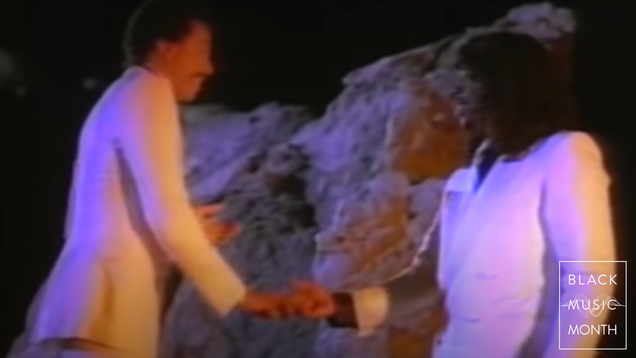
Have you ever watched something so ridiculous that it becomes both perfect and almost life-changing? That for me is the video for Rick James single featuring Smokey Robinson off of his 1983 album, Cold Blooded.
from The Root https://ift.tt/2BzB1jr

Have you ever watched something so ridiculous that it becomes both perfect and almost life-changing? That for me is the video for Rick James single featuring Smokey Robinson off of his 1983 album, Cold Blooded.
 The Ethiopian wolf, Canis simensis, is an endangered species. Fewer than 1,000 individuals are left in the wild. | Roger de la Harpe/Universal Images Group via Getty
Humans are causing a mass extinction. And humans can stop it.
Earth is now in the middle of a mass extinction, the sixth one in the planet’s history, according to scientists.
And now a new study reports that species are going extinct hundreds or thousands of times faster than the expected rate.
The researchers also found that one extinction can cause ripple effects throughout an ecosystem, leaving other species vulnerable to the same fate. “Extinction breeds extinctions,” they write in their June 1 paper in the Proceedings of the National Academy of Sciences.
With the accelerating pace of destruction, scientists are racing to understand these fragile bits of life before they’re gone. “This means that the opportunity we have to study and save them will be far greater over the next few decades than ever again,” said Peter Raven, a coauthor of the study and a professor emeritus of botany at Washington University in St. Louis, in an email.
The findings also highlight how life can interact in unexpected ways and how difficult it can be to slow ecological destruction once it starts. “It’s similar to climate change; once it gets rolling, it gets harder and harder to unwind,” said Noah Greenwald, the endangered species director for the Center for Biological Diversity, who was not involved in the study. “We don’t know what the tipping points are, and that’s scary.”
It’s worth pausing to reflect on what “extinction” means: a species completely and forever lost. Each one is an irreparable event, so the idea that they are not only happening more often but also might be sparking additional, related extinctions is startling. And these extinctions have consequences for humanity, from the losses of critical pollinators that fertilize crops to absent predators that would otherwise keep disease-spreading animals in check.
So researchers are now looking closely at which animals are teetering on the edge of existence to see just how dire the situation has become, and to figure out what might be the best way to bring them back.
There is tremendous biodiversity on earth right now. The number of species — birds, trees, ferns, fungi, fish, insects, mammals — is greater than it ever has been in the 4.5 billion-year existence of this planet. But that also means there is a lot to lose.
The new study examined 29,400 species of vertebrates that live on land — mice, hawks, hippos, snakes, and the like. These species from all over the world were cataloged by the International Union for Conservation of Nature.
Out of those examined, 515 species — 1.7 percent of those studied — were found to be on the brink of extinction, meaning fewer than 1,000 individuals were left alive. These species include the vaquita, the Clarion island wren, and the Sumatran rhino. And half of these 515 species have fewer than 250 individuals left. If nothing is done to protect them, most of them will go extinct over the next 20 years.
/cdn.vox-cdn.com/uploads/chorus_asset/file/20021581/Screen_Shot_2020_06_05_at_6.51.21_PM.png) PNAS
PNAS
But these species on the precipice of the abyss are not spread evenly across the world; they’re concentrated in biodiversity hotspots like tropical rainforests. That makes sense because tropical forests have the most variety of species to begin with and they have the highest rate of habitat destruction. “About two-thirds of all species are estimated to occur in the tropics, and we know less about them than those in other parts of the world,” said Raven. “[Y]et more than one-quarter of all tropical forests have been cut in the 27 years since the ratification of the Convention on Biological Diversity.”
The species teetering on the edge of eternal loss often live alongside other endangered species, even if they are present in greater numbers. The species on the brink then serve as loud sirens of the possible bigger threat to other life in their environs. As species within a pond, forest stand, or watershed die off, others soon follow.
In many cases, species interact with others in complicated and often unforeseen ways that aren’t recognized until they are gone. For example, if a plant-eating insect dies off, the plants it eats could run rampant and choke off other vegetation. Meanwhile, the birds that feed on the insect could be without an important food source. Each of these subsequent changes could have myriad other impacts on distant species, and so on and so on. The disruption can continue until the ecosystem is hardly recognizable.
Scientists have observed these kinds of rippling disruptions in ecosystems for decades in places like the Amazon rainforest, watching what happened when species went extinct in a given area or when a habitat fractured into pieces.
As these ecosystems degrade or collapse, humans stand to lose a lot of functions from nature they take for granted, like forests that generate rainfall for aquifers or mangroves that shield coasts from erosion. Many land vertebrates, for instance, are critical for spreading the seeds of trees. Without them, the makeup of a forest could transform.
Even if a less diverse prairie, forest, or desert were to remain, it would be more vulnerable to shocks like fires and severe weather. Diverse ecosystems act as buffers against environmental extremes, and without them, humans will face more risks of phenomena such as heat waves without vegetation to cool the air, or they may suffer more coastal inundation without mangroves to absorb waves.
And as humans build closer to areas that were once wild, they face higher risks of exposure to threats such as animal-borne disease and wildfire. So the economic and health costs of runaway extinctions could be immense.
The new study is part of a steady stream of grim news for endangered species. In 2019, the United Nations’ Intergovernmental Science-Policy Platform on Biodiversity and Ecosystem Services (IPBES) released a massive 1,500-page report on global biodiversity. The report concluded that up to 1 million species are at risk of extinction, including 40 percent of all amphibian species, 33 percent of corals, and about 10 percent of insects.
And a unifying theme among the various studies of extinctions is that humans are to blame.
Through destroying habitats, spreading disease, raising livestock, dumping waste, overharvesting, overfishing, and climate change, the 7.5 billion humans on this planet have become their own force, unlike any that exists in nature.
“We are in no sense simply a part of the global ecosystem anymore, living in a broad, wide world,” said Raven. “[W]e are one species, totally dominant, among the millions of others that exist.”
It’s true that species do go extinct naturally, but the rate of extinction now is thousands of times higher than the expected background rate. It can be difficult to tease out whether an organism disappeared as a direct consequence of human activity or because a species it depended on was wiped out by people, but both types of losses stem from humanity. “We can’t easily reverse the trend but can learn as much as we can in the time we have left,” Raven said.
However, the fact that human activity is driving the vast majority of these extinctions means that changing human activity can help pull back vulnerable species from annihilation.
Conservation policies have already proven effective at thwarting some permanent losses, like the Endangered Species Act in the United States. It’s even spurring the recovery of several species, like the bald eagle. And there is still time to rescue other species that are on the brink. But saving what’s left will require concerted action, and time to act is running out.
“You do not want to get into a deep depression. You want to get involved and do the very easy things we can do to prevent us from destroying the planet,” said Stuart Pimm, a professor of conservation at Duke University and president of Saving Nature, an environmental conservation nonprofit. “The important story is there is a lot we can do about it.”
Since humans are causing most of the destruction that is driving extinctions, humans can change their behaviors in ways to protect life. One of the most effective steps people can use to protect endangered species is to protect the environments where they live, shielding them from mining, drilling, development, and pollution.
“We can definitely make a difference. We can slow the pace of extinction,” Greenwald said. “We know how to do that. We can set aside more area for nature.”
Another tactic is building corridors for connecting fragmented ecosystems, creating larger contiguous areas. That can allow the synergy between species to grow and build a more resilient ecosystem that could better withstand the disappearance of a species and restore those in decline.
However, the threats to so many species have been building for years and they can’t be reversed overnight. It will take a sustained global conservation effort to protect the precious few and restore them to the multitudes that once swam, flew, and walked the earth.
Support Vox’s explanatory journalism
Every day at Vox, we aim to answer your most important questions and provide you, and our audience around the world, with information that has the power to save lives. Our mission has never been more vital than it is in this moment: to empower you through understanding. Vox’s work is reaching more people than ever, but our distinctive brand of explanatory journalism takes resources — particularly during a pandemic and an economic downturn. Your financial contribution will not constitute a donation, but it will enable our staff to continue to offer free articles, videos, and podcasts at the quality and volume that this moment requires. Please consider making a contribution to Vox today.
 Police shoot pepper bullets into a crowd of people demonstrating against police violence in Los Angeles on June 1. | Robert Gauthier/Los Angeles Times via Getty Images
“The system was designed this way”: A former prosecutor on the fundamental problem with law enforcement.
Every time a cop is caught brutalizing a black or brown person, I hear the same argument: “It’s just a few bad apples.”
I’m hearing this again in the wake of George Floyd’s murder. On Sunday, to take one example, National Security Adviser Robert C. O’Brien said, “We have got great law enforcement officers, not — not the few bad apples, like the officer [Derek Chauvin] that killed George Floyd. But we got a few bad apples that have given — given law enforcement a bad name.”
When asked by CNN’s Jake Tapper if he thought systemic racism was a problem for law enforcement, O’Brien replied: “No, I don’t think there’s systemic racism.”
Curiously, the people who recite this trope rarely reflect on the second half of the expression: “A few bad apples spoil the bunch.” But let’s set that aside.
No matter how you look at it, the American criminal justice system is riddled with biases. As the Washington Post’s Radley Balko cataloged, we know that black people are nearly twice as likely to be pulled over and more likely to be searched once they’re stopped even though they’re less likely to have contraband; and that unarmed black people are more than three times as likely to be shot by police as unarmed whites.
So how do we explain this reality?
Paul Butler is a law professor at Georgetown, a former federal prosecutor, and the author of the 2017 book Chokehold: Policing Black Men. His work has long focused on the fundamentals of America’s criminal justice system and why they keep reproducing the same outcomes for black Americans. I talked to him about how we got here, why he thinks the criminal justice system is working exactly as designed, and why the “few bad apples” argument is complete bullshit.
A lightly edited transcript of our conversation follows.
I’d like this conversation to speak as much as possible to people like me — a white guy who grew up in a small town in the South — who has no experience with any of this, whose life is untouched by this kind of threat, who may not understand why anyone would treat cops like an occupying force and is therefore skeptical of the sort of arguments you’re making.
What do you say to that person?
I’m glad you started there. I saw a compelling example of this on live TV last Saturday that helps to make the point. MSNBC’s Ali Velshi was reporting live from the protest in Minneapolis, and as he was reporting, he said, “They’re starting to shoot.” The cops were starting to fire rubber bullets. And the protesters were totally nonviolent. They weren’t doing anything provocative, and the police just opened fire. And we see it all live on TV.
As he’s running away, Velshi’s shot in the leg, but he just keeps reporting. Later, after he’s retreated, he sees the cops advancing again and he looks terrified in a way he hadn’t before. That’s the impact of violent policing on African Americans — and black men disproportionately bear the cost of that.
The point of policing the hood is to demonstrate that the police officer dominates. That he’s the man, regardless of gender, that the officer is the boss, and that everybody else is subordinate. The way that that message is communicated is with fear. Fear for your physical safety. I called this “torture lite” in my book Chokehold, and some people thought that that was extreme. But I was actually thinking about a specific thing in international human rights law, and a specific evolution of torture, from the horrible pulling out of your fingernails to the way it works now — which is to make people feel both humiliated and terrified that anything could happen to them at any moment.
A kind of psychological warfare —
Exactly. This attitude is present in a lot of police officers who work in communities of color, and it defines the dynamic between them and the people they’re supposed to be serving. It impacts all of us. I went to a fancy college and law school; I have a good job and drive a nice car. But every time there’s a police car behind me, my heart starts beating quickly. Every black man I know has the same story. Because you just never know.
That is such a wildly different dynamic than most white people have experienced. And for those people, many of them at least, there’s a reflexive dismissal of it. They’ll read this as hyperbole or anecdotal and in that sense refuse to grapple with the fundamental claim about the role law enforcement plays in black communities.
Let’s think about the Floyd case. Before we get to the killing, let’s think about the arrest. The store owner called the police and said that someone had tried to pass a fake $20 bill. The police respond, and what they do is virtually impossible to imagine happening to a white person. What they do is to approach Mr. Floyd’s car like he’s a violent thug. They order Mr. Floyd and the passengers to exit the car. One officer has his hand on his gun. They put Mr. Floyd in handcuffs. When he falls to the ground, they leave him on the ground in handcuffs, and then, as the whole world knows, they hold him down by his back and knee and legs for 10 minutes until he dies. I just can’t imagine that happening to a white person over a $20 bill.
Black and brown people experience very different treatment from the police than white people do, and it’s so endemic that the police just can’t help themselves. I thought the most compelling example of that was how differently the CNN reporters were treated in Minneapolis. A white CNN reporter is basically on the same ground, doing the same thing — while cops roll up on the black reporter and arrest him, cops go to the white reporter and say, “We’d like you to move, please,” and he says, “Okay.” But he doesn’t move as far as they would like and they say, “Could you please move some more?” And he says, “Sure.”
The thing that’s so revealing about that is that it all happens on national television, at a rally about excessive force and racist policing. I could just imagine, at the roll call that morning for the officers, when they’re getting their instructions from the sergeant, the sergeant says, “Okay, guys, we know that we’re guarding this rally about police brutality and discriminatory enforcement; let’s not be racist, don’t be racist, it’s really important that we not be racist today.” And they still can’t help themselves.
You say we don’t merely have two systems of justice, one for white people and one for black and brown people, but instead we have “opposite” systems of justice. And the system for black and brown people isn’t broken — it’s working exactly as designed. What does that mean?
Part of the evidence that the system was designed this way, and one of the reasons it recurs over and over again, is because a lot of the conduct that people of color complain about is totally legal. So I don’t think the case against the officers in the Floyd case is a slam-dunk by any means. The defense will be that their use of force was reasonable. And they have a case to make. They don’t have a great case, given that Mr. Floyd was handcuffed, but what they will say is that he was resisting arrest and they used reasonable force to subdue him. And obviously there comes a point where the reasonableness of that force is extinguished by the fact that his body is lying limp and motionless on the ground. But up until then, I think they have an argument that what they were doing was legal.
Outside of that case, in theory, the power that police have is unreal. I have a police officer buddy who comes and visits my criminal law class, and to demonstrate how much power he has, he invites my students to go on a ride-along in his car, to see what it’s like to patrol the streets of DC. He plays a game with them called Pick That Car. He tells the student, “Pick any car that you want, and I’ll stop it.” So the student will say, “How about that white Camry over there.”
He’s a good cop. He waits until he has a legal reason. But he says that he could follow any car, and after five minutes or three blocks, the driver will commit some traffic infraction, and then under the law he has the power to stop the car, to order the driver and the passengers to get out of the car. If he has reasonable suspicion that they might be armed or dangerous, he could touch their bodies, he can frisk them, he can ask to search their car. And it’s totally legal. That’s an example of the extraordinary power that police have.
And that extraordinary power, that constitutional power, is used more aggressively against black and brown men than against white soccer moms.
In a way, that gets to the heart of this. Because the difference here is how the same laws are applied differently to different people. We’re not talking about different rules for different people formally codified into law. We’re talking about the enormous discretion cops have and how, for too many reasons to count, they apply it unevenly.
That’s exactly right. I know it sounds kind of conspiratorial when I say it’s designed that way, but one reason I think that is because it happens so often and it’s so predictable. And in these kinds of cases, advocates tell the Supreme Court that if you give the police this kind of power, they’re going to use it unfairly against people of color. And we have tons of data backing that up. And the Court either discounts that concern or says, “There’s nothing that we can do about it.”
So everybody knows how the police will use this power, and true enough, they do. That’s why I think that the Ferguson report, which is the report that the US Department of Justice wrote after the uprising in Ferguson, and after Michael Brown was killed, I think that’s one of the defining artifacts of our time.
Why?
A hundred years from now, when people want to know what it was like to be alive in 2020, the Ferguson report is one of the things they’ll look at. It’s this amazing synthesis of data and stories. The data includes the fact that every single time the police used a dog in Ferguson, they used it against a black person.
Can I give you just one quick story from the report to show you why I think it’s so revealing?
Please.
So there’s one story in there in which a woman calls the police because her boyfriend’s beating her up. By the time the police get there, he’s gone. The police look around the apartment and they say, “Does he live here?” And she says, “Yes, he does.” The police say, “You’re under arrest for occupancy permit violation, because his name isn’t on the lease.” When that happened to another woman in Ferguson, she said she would never call the police again, she didn’t care if she was being killed. Again, this is how the police do black people and brown people. They don’t treat white people like this, certainly not as systematically as they do black and brown people.
I want to ask you about this argument that the policing problem can be reduced to “a few bad apples.” Your book is largely about this, and I’d like to know why you think it’s bullshit.
For one, it’s insulting to police officers. I don’t think police officers are any more racist than law professors or doctors or anybody else. In fact, I think that some people go into that work because they want to be warriors, and that’s not constructive, so when we think about change, we need to think about guardianship as a model, not war.
But I think a lot of people go into the work because they really want to help communities, and they really want to make a difference, and this belief is based on my experience as a prosecutor working with police officers of all backgrounds and of all races. So I don’t think that police officers are especially racist. But I do think we give them tools and authority in a context that leads them to deploy it unjustly against people of color.
The real question we need to answer isn’t, “Why are racist cops doing racist things?” (that question answers itself) but rather how is it that non-racist cops, or cops who set out with good intentions, succumb to perverse incentives and end up enforcing inequalities they themselves would probably reject in the abstract.
Right, and I think it’s about the workplace culture. I tell the story that after I graduated from law school, I worked for a law firm for a couple of years, and then I decided I wanted to be a prosecutor. So I was lucky enough to get a job with the Department of Justice, where they have drug tests. I had been smoking weed recreationally before I joined the Justice Department. When I joined the Justice Department, because I didn’t have any trial experience, they sent me to the local prosecutor’s office in DC to learn how to try a case. You start out doing low-level cases, including, at that time, marijuana possession and marijuana distribution. I stopped smoking weed just because I knew that there were drug tests, and I didn’t want to lose my job. But I prosecuted people for smoking weed. So I understand workplace incentives, and none of us are immune to it.
The culture of law enforcement is very much a paramilitary culture. You’re part of a team and you have to have each other’s back. Part of the reason your question is so important is that we’re not just talking about white cops, we’re also talking about black cops. Police officers of color get caught up in the same loops. In hip-hop, there’s a lot of interest in black police officers, and the message you often hear is that black officers are actually worse than white officers, because they want to show off for the white cops.
So the problem is about culture, and it runs much deeper than a few racists here and there.
If the problem were merely racist cops, the solution would be easy: screen for racists and remove them. But if the real problem isn’t bad cops or bad policing so much as a culture built on a racial hierarchy that law enforcement has historically protected and reinforced, then it’s hard to see a path forward.
It’s a huge problem and I don’t know how to solve it, but what I do know is how to make a difference in individual cases in a way that will prevent people from getting killed or beat up, or having the law selectively applied to them. I know that there are reforms that can save lives, and even if they’re not going to crush white supremacy, if Sandra Bland and George Floyd can live rather than die, I’m cool with that on the way to transformation.
What sort of reforms?
In Chokehold, I argue that people tend to see the problems between black people and police in four different ways. So really quickly, the first way is that the problem is black men. It’s the way that we perform masculinity. If we would just pull up our pants, we wouldn’t have to worry about being stopped and frisked. There are quite a lot of people who think that.
The second framing is that the problem is under-enforcement of law, not over-enforcement. That what the black community needs even more than other communities is law and order. So when police selectively enforce the law in those communities, it’s actually a kind of reparations, it’s a payback for the time when 911 was a joke. And my friends who are prosecutors and police officers of color, that’s what they say. They say, “Hell yeah, I’m tougher in the hood than I am in the suburbs, because that’s my community.” That’s how they think.
Then there’s what I’d call a more liberal framing, which focuses on the relationship between black people and cops, like the problem is that they’re in a bad marriage and they just need to understand each other. This was very much the approach of the Obama administration, emphasizing the need to bring people together alongside tangible reforms like more body cameras and better training.
The fourth way of thinking about the problem is the focus on white supremacy. This is the new Jim Crow idea. Here, what people suggest is that if you only work on the police, that’s treating the symptom. But the disease will metastasize. So in this telling, it started with slavery, went to the old Jim Crow, and now it’s the new Jim Crow, enforced via a racially biased criminal justice system. And so the only way things will truly get better is to crush white supremacy.
I’m sympathetic to the new Jim Crow point of view, but at the same time, we can save lives in other ways before we crush white supremacy. That’s why I think the third framing through a liberal lens remains very useful, even if at the end of the day it’s not going to create the transformation we need, it’s worth it if it will save lives.
So in the meantime, we can make a difference by teaching cops to intervene when their peers are crossing the line, by teaching them how to deescalate, by changing our entire approach to nonviolent criminal arrests. These things are not going to bring the revolution, but they can save lives.
Do you think it’s possible for us to break this cycle?
To me, that’s almost a question about faith. About your belief in humanity. Martin Luther King says the arc of the moral universe bends toward justice. I hope that’s right. One of the most poignant moments of that horrific video [of Floyd’s death] is there’s a bystander who says to the cop, “Bro, he’s human.” The truth is that I don’t think those police officers saw Mr. Floyd as human. And I’m not sure that’s a problem that can be solved by a reform.
Support Vox’s explanatory journalism
Every day at Vox, we aim to answer your most important questions and provide you, and our audience around the world, with information that has the power to save lives. Our mission has never been more vital than it is in this moment: to empower you through understanding. Vox’s work is reaching more people than ever, but our distinctive brand of explanatory journalism takes resources — particularly during a pandemic and an economic downturn. Your financial contribution will not constitute a donation, but it will enable our staff to continue to offer free articles, videos, and podcasts at the quality and volume that this moment requires. Please consider making a contribution to Vox today.
 The state militia was called in on the south side of Chicago during the 1919 race riots. | Chicago Tribune historical photo/Tribune News Service via Getty Images
“The problem is the way policing was built,” historian Khalil Muhammad tells Vox.
Eugene Williams, a 17-year-old black boy, was stoned to death by white people in 1919 after he swam into what they deemed the wrong part of Lake Michigan.
In response, black people in Chicago rose up in protest, and white people attacked them. More than 500 people were injured and 38 were killed. Afterward, the city convened a commission to study the causes of the violence.
The commission found “systemic participation in mob violence by the police,” Khalil Muhammad, a professor of history, race, and public policy at Harvard Kennedy School and author of the book The Condemnation of Blackness: Race, Crime, and the Making of Modern Urban America, told Vox. “When police officers had the choice to protect black people from white mob violence, they chose to either aid and abet white mobs or to disarm black people or to arrest them.”
In the process of compiling the report, white experts also testified that “the police are systematically engaging in racial bias when they’re targeting black suspects,” Muhammad said. The report “should have been the death of systemic police racism and discrimination in America.”
That was in 1922.
It’s almost 100 years later, and thousands of Americans are in the streets daily, protesting the same violence and racism that the Chicago commission documented. It may seem like nothing can change, but Muhammad said the last several weeks could be a wake-up call for some Americans to what policing in this country really means.
Part of that awakening, though, also involves understanding the history of police violence. Muhammad’s work focuses on systemic racism and criminal justice; The Condemnation of Blackness deals with the idea of black criminality, which he defines as the process by which “people are assigned the label of criminal, whether they are guilty or not.” That process has been a vicious cycle in American history, Muhammad explains, wherein black people were arrested to prevent them from exercising their rights, then deemed dangerous because of their high arrest rates, which deprived them of their rights even further.
I spoke with Muhammad by phone to better understand this history, what it means today, and what it would take to make 2020 and beyond different from 1922. A transcript of our conversation, lightly edited for length and clarity, follows.
Can you trace how the idea of black criminality appeared in America, starting with slavery?
The notion of criminality in the broadest sense has to do with slave rebellions and uprisings, the effort of black people to challenge their oppression in the context of slavery. Slave patrols were established to maintain, through violence and the threat of violence, the submission of enslaved people. But we really don’t get notions of black criminality in the way that we think of them today until after slavery in 1865.
The deliberate choice to abolish slavery, [except as] punishment for crime, leaves a gigantic loophole that the South attempts to leverage in the earliest days of freedom. What that amounts to is that all expressions of black freedom, political rights, economic rights, and social rights were then subject to criminal sanction. Whites could accuse black people who wanted to vote of being criminals. People who wanted to negotiate fair labor contracts could be defined as criminals. And the only thing that wasn’t criminalized was the submission to a white landowner to work on their land.
Shortly afterwards, a lot of the South builds up a pretty robust carceral machinery and begins to sell black labor to private contractors to help pay for all of this. And for the next 70 years, the system is pretty much a criminal justice system that runs alongside a political economy that is thoroughly racist and white supremacist. And so we don’t get the era of mass incarceration in the South, what we get is the era of mass criminalization. Because the point is not to put people in prison, the point is to keep them working in a subordinate way, so that they can be exploited.
What was happening in the North while this mass criminalization was happening in the South?
There had already been African Americans [in the North] before the end of slavery, and they were subjected to forms of segregation. But it wasn’t really until the beginning of the 20th century, when streams of black migrants began to move to northern cities, and particularly during World War I and what became known as the Great Migration, that we began to see the increased ascription of black people as prone to criminality, as a dangerous race, as a way of essentially limiting their access to the full fruits of their freedom in the North.
Social science played a huge role. What we’d call today “academic experts” of one kind or another, were part of the effort to define black people as a particular criminal class in the American population. And what they essentially did was they used the evidence coming out of the South, beginning in the first decades after slavery. They used the census data to point to the disproportionate incarceration of African Americans. They were almost three times overrepresented in the 1890 census in southern prisons.
So that evidence became part of a national discussion that essentially said, “Well, now that black people have their freedom, what are they doing with it? They’re committing crimes. In the South and in the North, and the census data is the proof.”
And so people began to build on that data and add to it. Police statistics began to become more important in determining how black people were doing, whether they were behaving or not. We quickly moved from census data to local data, from South to North, and we begin to see the consolidation of a set of facts that black people have a crime problem.
So it’s a cycle: Black people were incarcerated in the South, and because they were incarcerated, this whole theory that black people were criminal was built on top of that?
That’s exactly what I’m saying. Of course, there’s no footnotes or asterisks to what was happening in the South. People just take the data at face value, kind of like people take the data at face value today. They just look at the data and say, “Oh, well of course, look what’s happening in these communities.”
How do we see these attitudes about black criminality play out in policing around the country, leading up through the 20th century to the present?
Once we have the consolidation of the fact that crime statistics prove nationally, everywhere, that black people have a crime problem, the arguments for diminishing their equal citizenship rights are national. They’re not just southern any longer. And they’re at every level of society — local, state, federal.
They are existing in cultural products like The Birth of a Nation, the first truly major Hollywood film release. Black criminality becomes the most dominant basis for justifying segregation, whether legal or by custom, everywhere in America.
It had already defined the heart of the Jim Crow form of segregation, but it really begins in the Great Migration period to shape the maldistribution of public goods for black people — access to neighborhoods, access to schools, access to hospitals, access to forms of leisure. And, of course, all of these restrictions are enforced by white citizens but most especially by local law enforcement, by police officers.
In the South, police were less on the front lines because there were fewer of them. There was more vigilante enforcement of white supremacy: A white man really could shoot a black man or woman down in the middle of the street and get away with it. That was less likely to happen in the North — what was more likely to happen was for a white resident to simply call the police.
The same basic idea that in white spaces, black people are presumptively suspect, is still playing out in America today. The idea that police officers should prevent crime in black communities, rather than simply policing the borders of black communities, is what gave us stop and frisk, which actually is not just from the 1990s or inspired by “broken windows” policing, but versions of it were playing out very officially in the 1960s. And by looking at the archives, which I’ve done in my book, unofficially and unnamed, going back to the 1910s and ‘20s.
So this idea that you can prevent crime in a community where the crime statistics say a lot of crime happens, and presume that a certain demographic of black men — especially in that community — are likely criminals, that logic begins as early as the 1960s. And it’s still playing out.
While that pattern played out, one of the things that happens during Prohibition is that the manufacturing and distribution of alcohol creates this massive underground economy, which is now being regulated by white ethnic men who don’t sue each other in civil court, but actually shoot at each other when they’re competing over the spoils of bootlegging. And a lot of that action is deliberately put in black communities.
The speakeasies, the corruption is hidden within black communities. Everyone is complicit in this: The bootleggers are complicit, the police are complicit. The only people who aren’t complicit are everyday working-class black people who don’t want what’s happening in their communities to be happening.
The effect of that is to produce yet another battery of crime statistics coming out of northern cities that shows high rates of arrest of black people during the Prohibition period, when in fact, they’re being targeted for political clampdowns of overwhelmingly white underground activity. It’s just remarkable.
And yet again, the white public doesn’t read any footnotes or get any asterisks to it. What they get is evidence of disproportionate numbers of arrests in the black community during a time where just about everybody knew who was behind bootlegging.
[But] black people — black reformers, black activists, black scholars, black journalists — were always documenting what was happening to them. They were always resisting and they made some headway, beginning in the 1920s, around calling attention to systemic police racism and discrimination.
That’s the next thing I wanted to ask about. I know that you wrote about this a little bit in your Washington Post op-ed last year — talk to me a little bit about the history of protests against racist policing.
The earliest days of the civil rights movement were focused on the problem of lynching. The NAACP literally begins because of lynching. And [one] reason was because of the threat of lynching in the North. It’s not to say that the progressives who founded the organization in 1910 didn’t care about lynching that had been going on in the South. But it was kind of like a George Floyd moment. It was like, “Holy smokes, if this can happen in Springfield, Illinois, where a lynching had occurred in 1909, then we’ve got to draw a line in the sand.”
Alongside their focus on racial violence in the earliest days, they also began to pay attention to police violence, particularly in the North, because the NAACP leadership was in northern cities. It was headquartered in New York. And so what was happening in their own backyards was more like systemic police violence than lynch mobs. And that began the process, particularly for W.E.B. Du Bois, who establishes kind of a police blotter, or let’s call it a police-brutality blotter, and the primary magazine for the organization.
Ida B. Wells, who was also another founder of the NAACP, begins to organize around police violence and other forms of racial violence in those cities. African Americans themselves start to resist policing and call attention. Ministers, teachers, bricklayers — essentially what was the working and professional class of black America at the turn of the 20th century are very vocal, and they demand police reform. They demand accountability for criminal activity amongst the police and they don’t get any of it.
By the 1920s, the first of a series of race riots erupts in East St. Louis, spreads to Philadelphia. Another one occurs in Chicago. The Chicago one is sparked by the death of a [17-year-old] swimming in Lake Michigan who crosses an aqueous color line. Black people are outraged. They want justice. White people take offense and begin to attack them in their communities.
And what comes out of that is the first blue-ribbon commission to study the causes of riots. In that report, the Chicago commission [concludes] that there was systemic participation in mob violence by the police, and that when police officers had the choice to protect black people from white mob violence, they chose to either aid and abet white mobs or to disarm black people or to arrest them. And a number of people testify, all of whom are white criminal justice officials, that the police are systematically engaging in racial bias when they’re targeting black suspects, and more likely to arrest them and to book them on charges that they wouldn’t do for a white man.
This report in 1922 should have been the death of systemic police racism and discrimination in America. It wasn’t. Its recommendations were largely ignored.
And a decade later, Harlem breaks out into what is considered the first police riot, where African Americans believe that an Afro-Puerto Rican youth has been killed by the police. Turns out he hadn’t been, but the rumor that he had leads to a series of attacks directed towards white businesses in Harlem and against the police. And eventually, that uprising leads to the Harlem riot report in 1935.
That report comes to the same conclusion, notes there needs to be accountability for police that need to be charged and booked as criminals when they engage in criminal activity. They call for citizen review boards and an end to stop and frisk, which they name in the report. And Mayor [Fiorello] La Guardia, the mayor of New York, shelves it, doesn’t do anything with it, doesn’t even share [it] with the public. The only reason it ever saw the light of day was because the black newspaper, the Amsterdam News, published it in serial form.
And a similar report is produced in 1943, and another report in 1968. They essentially all keep repeating the same problem.
Given the history of clear identification of this problem, is now any different? Are we seeing any shift in attitudes of white Americans toward the idea of black criminality? Will we see any changes come out of this moment?
If we count the last two weeks as evidence of some outward show of consciousness and commitment to something different, I would say this: This moment is very helpful when it comes to taking on this question. The problem is that none of us can know how long this will last. None of us can know whether the simple charging of three other men and eventual conviction for all involved in the killing of George Floyd will be the answer people were looking for who are newcomers to this.
But I can tell you that a lot of the activists and movement leaders, the organizers, academics like myself, know that this has never been a problem about one, two, three, or four officers who unjustly kill an unarmed, innocent black person — and I say innocent because George Floyd had not been convicted of anything. We know that this has never been about that.
The problem is the way policing was built and what it’s empowered to do, which is — to put it in terms that are resonant in this moment — they’ve been policing the essential workers of America. And the fact that black people over index as the essential workers of America, when in fact, that was what their presence here was meant to be about: to provide the labor to build wealth in America, and then the only form of freedom that they really ever had, which was the freedom to work for mostly white people.
In this pandemic moment, I think we’re able to see more clearly that the very people we’re willing to sacrifice the civil rights and civil liberties of are the very people we also depend upon to keep our utilities running and our groceries coming into our homes.
What this moment leads us to is a crossroads for most newcomers to define justice beyond an individual case or even cases, but to define justice as a form of limiting what police officers have been able to do, which is to protect white privileges in America. Some people call that defunding the police. Some people call it abolition. But what it all means is that there should be less policing of black America and more investment in the [socioeconomic] infrastructure of black communities. And police officers are not the people to do that work.
Support Vox’s explanatory journalism
Every day at Vox, we aim to answer your most important questions and provide you, and our audience around the world, with information that has the power to save lives. Our mission has never been more vital than it is in this moment: to empower you through understanding. Vox’s work is reaching more people than ever, but our distinctive brand of explanatory journalism takes resources — particularly during a pandemic and an economic downturn. Your financial contribution will not constitute a donation, but it will enable our staff to continue to offer free articles, videos, and podcasts at the quality and volume that this moment requires. Please consider making a contribution to Vox today.
 Photo by Ira L. Black/Corbis via Getty Images
The NFL just issued a statement saying it was wrong to censure players who protested police violence.
NFL players have protested police brutality and racism — the same problems now being demonstrated against across the country — for seasons beginning in 2014, and the NFL pushed back against these players, saying that they “created a false perception among many that thousands of NFL players were unpatriotic.” Now that has changed, with the league advocating for anti-racism activism in a Friday statement.
“We, the NFL, admit we were wrong.” That’s what the NFL tweeted in an official statement on Friday night, in which the organization apologized for not listening earlier to the black NFL players who have protested against the police shootings of unarmed black people by kneeling during the national anthem at football games. The statement goes on to add that the NFL “encourage[s] all to speak out and peacefully protest,” and concludes, “We, the NFL, believe Black Lives Matter.”
The tweet was accompanied by a video from NFL commissioner Roger Goodell. In the video, Goodell reiterates the statement in the tweet. “Without black players, there would be no National Football League,” he adds. “And the protests around the country are emblematic of the centuries of silence, inequality and oppression of black players, coaches, fans and staff.”
We, the NFL, condemn racism and the systematic oppression of Black People. We, the NFL, admit we were wrong for not listening to NFL players earlier and encourage all to speak out and peacefully protest. We, the NFL, believe Black Lives Matter. #InspireChange pic.twitter.com/ENWQP8A0sv
— NFL (@NFL) June 5, 2020
The NFL’s statement is an explicit response to a video multiple prominent NFL players released on Thursday. In the video, a group of players that included Patrick Mahomes and Tyrann Mathieu of the Kansas City Chiefs and Michael Thomas of the New Orleans Saints demanded accountability from the NFL.
“We will not be silenced. We assert our right to peacefully protest,” the players said. “It shouldn’t take this long to admit.” They asked that the NFL deliver the very message that it tweeted out, verbatim, on Friday night.
The NFL’s new statement comes after years spent condemning players who knelt during the national anthem. When that movement was at its height in 2018, league officials threatened to fine players who “disrespected” the flag or the national anthem by kneeling. Players who wanted to kneel could do so only behind the closed doors of changing rooms.
Colin Kaepernick, who began the movement in 2014, has not played football since 2016. There is no word on whether this change in course means he will be rehired by an NFL team.
Support Vox’s explanatory journalism
Every day at Vox, we aim to answer your most important questions and provide you, and our audience around the world, with information that has the power to save lives. Our mission has never been more vital than it is in this moment: to empower you through understanding. Vox’s work is reaching more people than ever, but our distinctive brand of explanatory journalism takes resources — particularly during a pandemic and an economic downturn. Your financial contribution will not constitute a donation, but it will enable our staff to continue to offer free articles, videos, and podcasts at the quality and volume that this moment requires. Please consider making a contribution to Vox today.