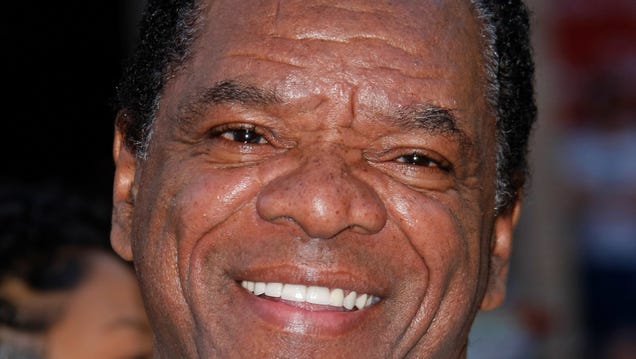
John Witherspoon, the “Pops” and “Grandad” of Black Hollywood, has died at the age of 77. The actor-comedian died suddenly in his home on Tuesday.
from The Root https://ift.tt/2JA7mb9

John Witherspoon, the “Pops” and “Grandad” of Black Hollywood, has died at the age of 77. The actor-comedian died suddenly in his home on Tuesday.
Media mogul Byron Allen has become a champion for change, fighting to break barriers with a multibillion-dollar lawsuit against Comcast and Charter Communications for not distributing his networks.
READ MORE: WATCH: The must-see message for Black America about Byron Allen’s multi-billion dollar lawsuit
The CEO of Entertainment Studios sat down with The Breakfast Club’s Charlamagne Tha God, Angela Yee and DJ Envy, for a captivating conversation about his rise from bankruptcy to a billionaire. Within the interview he also pays homage to his single mother, who he credits for paving the way for his foray into entertainment.
The Detroit native said it was his 17-year-old single mother, who first taught him the art of being persistent. This discipline is something that he has found to come in handy in his fight for equality. A child born during the civil rights, his mother moved the family from Detroit to L.A. in 1968, during the tumultuous aftermath of Rev. Martin Luther King Jr.‘s death.
“I’ll be the first to say if the mothers succeed, so will the children,” Allen acknowledges. “And if mothers fail, most likely, so will the children.”
The mogul continued talking about his mother, and how her venture into entertainment inspired him.
“…my mother was at UCLA and getting her master’s degree in cinema TV production, she went to NBC and said, ‘Can I get a job?’ and they said, ‘No.’,” Allen reflects. “And her persistence really paid off. She said she asked a very important question, and she asked a question that changed our lives. She asked, ‘Do you have an internship?’ And they said, ‘No.’ And then she went to the next question. ‘Will you start one with me?’ And they said ‘Yes.’.”
That type of tenacity Allen said was a “game changer.” It set the wheels in motion to open doors for him, as his mother navigated her way through various jobs at NBC. And since childcare wasn’t an option, he got a front seat to seeing rising stars take center stage.
“I would just watch Johnny Carson do The Tonight Show, and I watch Red Fox do Sanford and Son… and Richard Pryor do his specials and Freddie Prinze do Chico and the Man. And then I would go and watch an unknown sportscaster do the local news, Bryant Gumbel.”
Allen learned about the power dynamics from behind the scenes, and his mother’s refusal to accept “no” was catalyst that help him carve out a path to becoming the executive who now owns the Weather Channel and TheGrio. It was a rough road pitted with rejection, but his focus seems to be laser sharp.
“I started my company from my dining room table in 93, and I did a television special making a bunch of funny friends. I remember that.” Allen said.
“So weekly, one hour show called Entertainers would buy or now. Yes. And I started I sat in my dining room table when I called all thirteen hundred television stations and asked them to carry the show for free. And on average, they all told me no about 50 times,” he admits.
“And literally, I sat in my dining room table from sunup to sundown and I got about fifty thousand nos. And after a year of doing that, I was able to squeeze out about one hundred and fifty yeses. And I got a station, a TV station in every market from New York to Waterloo Island. Right. And so that was my lineup. Now, Tribune, it said to me, and if you get 75 percent of the country, we will sell your commercial time. Because I said to the TV stations, there was 14 minutes of commercial time. I’ll keep seven minutes. You keep seven minutes. I’ll sell my seven minutes to national advertisers, you, local TV station, you sell your seven minutes to local advertisers. Right. You sell it to local banks, car dealers, supermarkets. I’ll sell my seven minutes to McDonald’s and Pepsi, and Johnson and Johnson and General Motors. You sell yours to the local market.”
Allen said he poured lots of sweat equity into doing the work. And he did, “Everything myself. It is the hardest thing I’ve ever done.”
More poetic is that Allen rose to become a force in the entertainment industry that has shaken several major media conglomerates to the core.
Allen alleges the Comcast and Charter Communications networks were specifically in violation of the Civil Rights Act of 1866, which prohibits racial discrimination in contracting, which he believes is broadening the divide for Blacks.
The Supreme Court has agreed to hear the $20 billion dollar case in November, and if Allen wins it would be a major victory for Black-owned companies and Black media.
In fact, the power of empowering our own and representation is one reason Allen says he bought TheGrio.
“I felt it was important than buying TheGrio to own, you know, our voice, to own our position in the marketplace, to really control our narrative, you know, with. So, you know, it’s very important to me because when my children were born, I had a guy say to me, you know, a white guy says to me, why is it important that you have Black ownership?”
“You know, what’s wrong with Black targeted? Is there a lot of Black faces? And I said, I’m glad you asked me that question. You know, let me tell you why I bought TheGrio, and why I bought a movie distribution company, why I own 10 cable networks. Let me ask you something. As a white man who has children. Are you comfortable with me controlling the images of your daughters and how they are produced and how they’re depicted and how they grow up looking at themselves? Are you cool with me having 100 percent control over how your white daughter sees herself? And he said no. And I said, great. I said, I expected you to answer the question that way. Now understand me as a Black man and my Black daughters. Now that. They’re here. I’m going to take a seat at the table and I’m going to control how they’re produced and how they’re depicted and how they grow up and how they see themselves. Because at this moment in my life, nothing is more important to me than them.”
The interview struck a chord with Charlamagne Tha God, who rated it as one of his top 3 conversations of the year.
Allen has undeniably become a formidable voice in a space that has tried to silence him. Check out the full interview here.
The post Byron Allen sits with ‘The Breakfast Club’ to talk business and hard work appeared first on theGrio.
John Witherspoon, beloved actor/comedian of film and television, has died at the age of 77 and his famous co-stars and fans from his decades long career are paying tribute.
According to a statement from Witherspoon’s family given to Deadline, the Detroit native died in California at his Sherman Oaks home on Tuesday night.
Deadline statement:
“It is with deepest sorrow that we can confirm our beloved husband and father, John Witherspoon, one of the hardest working men in show business, died today at his home in Sherman Oaks at the age of 77. He is survived by his wife Angela, and his sons JD, Alexander, and a large family. We are all in shock, please give us a minute for a moment in privacy and we will celebrate his life and his work together. John used to say ‘I’m no big deal’, but he was huge deal to us.”
So…my Dad died today & honestly I’m not sure how to feel. I’m sad, but I’m also happy 4 all the great times we had together. We’d roast each other like homies more than Father & Son, and I really liked that. He was my best friend & my idol.
Love U Dad…I’ll miss u.
– J.D. pic.twitter.com/zvzep5S11I
— J.D. (@jdwitherspoon) October 30, 2019
Witherspoon was a beloved figure in Hollywood best known for scene stealing roles in hit tv shows and films such as Friday, Boomerang, The Boondocks, Hollywood Shuffle and more. His catchphrases from those roles (many of them improvised) are deeply embedded in Black culture. #RIPPops
Look at how some of Witherspoon’s celebrity co-stars and fans like Ice Cube, Regina King and Marlon Wayans are honoring his legacy on social media.
My dad, my grandpa, my comedic inspiration! I love you Spoons! Rest In Paradise, King pic.twitter.com/U6GsNrrKXF
— Regina King (@ReginaKing) October 30, 2019
I’m devastated over the passing of John Witherspoon. Life won’t be as funny without him. pic.twitter.com/gtmiZiEppP
— Ice Cube (@icecube) October 30, 2019
Rest in Peace. This was one of the most talented comedians ever. A humorist. He brought instant joy. True Joy. John Witherspoon Dies: Comedian & ‘Friday’ Star Was 77 – Deadline https://t.co/kzz9p2LorZ
— Wendell Pierce (@WendellPierce) October 30, 2019
Very sad to report .. Thank you John for hiring me when I needed it the most!! Make God Laugh John Witherspoon Dies: Comedian & ‘Friday’ Star Was 77 – Deadline https://t.co/B0bHzjg5NN
— Loni Love (@LoniLove) October 30, 2019
Damn! Rest easy OG, thank you for sharing your gifts with us, that infectious smile & laugh, and most of all the knowledge & experience. You are appreciated to the utmost! #RIPJohnWitherspoon 🙏🏾🙏🏾🙏🏾 https://t.co/QO3sgWJiyq pic.twitter.com/ZCFqR9pf0O
— OMAR EPPS (@omarepps) October 30, 2019
The post RIP Pops: Regina King, Marlon Wayans, Ice Cube and more pay tribute to John Witherspoon appeared first on theGrio.
Today on the popular morning radio show The Breakfast Club, media mogul Byron Allen sounded the alarm on an attack of the Civil Rights Act of 1866–the original civil rights act, which protected newly freed slaves by ensuring fair government and commercial contracting.
Allen, who is CEO of Entertainment Studios (parent company of The Weather Channel and theGrio), recently sued Comcast in a $20B civil rights lawsuit. Allen had appealed to the 9th Circuit using the Civil Rights Act of 1866 against Comcast’s disproportionate funding of black networks.
“The industry spends billion[s] a year licensing cable networks, billion[s] and African-American owned media gets 0. And that’s not fair,” Allen told hosts Angela Yee, Charlamagne Tha God and DJ Envy.
When the 9th Circuit upheld Allen’s appeal twice, Comcast took the case to the Supreme Court, making a legal argument which threatened the very purpose of the Civil Rights Act of 1866.
That argument looks to interpret the law so that it can only be used if racial discrimination is 100% of the reason that a business is being discriminatory. If even 1% of the discrimination is perceived to have come from a non-racial standpoint, then businesses will not necessarily be held accountable for “mostly” racist practices.
Multiple civil rights organizations have voiced their support in an amicus brief, including the NAACP, the National Urban League, Color of Change, and the National Association of Black Journalists (NABJ).
Several members of the Congressional Black Caucus, an organization co-founded in 1971 by the legendary late Congressman John Conyers Jr. and other elected Black officials to advocate for shared political interests, have signed the amicus brief defending the Civil Rights Act of 1866.

According to Deadline, among those who have lent their voice in protest include presidential candidates and Senators Kamala Harris and Senator Cory Booker, and representatives Ayanna Pressley, Karen Bass, and Joyce Beatty. Non-CBC members such as Senators Richard Blumenthal and Ron Wyden have also signed the brief as well.
“As members of Congress, amici have a strong interest in ensuring that the laws Congress has passed are interpreted in a manner that is consistent with their text, history, and Congress’s plan in passing them,” says the brief filed by The CBC. “…The statute at issue in this case—42 U.S.C. § 1981—was passed immediately after the Civil War as part of a broader effort to ensure that the newly freed slaves enjoyed the same rights as other citizens.”
The brief continued, “This Court should not rewrite Section 1981 and disturb the vital protections that Congress passed that statute to provide.”
But the Congressional Black Caucus is incredibly large and wide-ranging, and includes members who did not sign the brief such as Representatives Maxine Waters, John Lewis, and Ilhan Omar.
The remaining membership includes:
Alma Adams
Colin Allred
Sanford Bishop
Lisa Blunt Rochester
Anthony Brow
G.K. Butterfield
Andre Carson
William Lacy Clay Jr.
Emanuel Cleaver
Jim Clyburn
Danny Davis
Antonio Delgado
Val Demings
Dwight Evans
Marcia Fudge
Al Green
Alcee Hastings
Jahana Hayes Democratic
Steven Horsford
Hakeem Jeffries
Eddie Bernice Johnson
Hank Johnson
Robin Kelly
Brenda Lawrence
Al Lawson
Sheila Jackson Lee
John Lewis
Lucy McBath
Donald McEachin
Gregory Meeks
Gwen Moore
Joe Neguse
Eleanor Holmes Norton
Ilhan Omar
Stacey Plaskett
Cedric Richmond
Bobby Rush
David Scott
Terri Sewell
Bennie Thompson
Lauren Underwood
Marc Veasey
Maxine Waters
Frederica Wilson
Editor’s Note: theGrio is owned by Entertainment Studios.
The post Which members of the CBC have spoken up about the attack on the Civil Rights Act of 1866? appeared first on theGrio.
Scaling to a new milestone, Inclusion Initiative member companies have an aggregate spend of $1.6 billion on black law firms and other minority firms along with women-owned (MWBE) law firms.
The new number was provided last month by the Inclusion Initiative, a collaborative program among law departments at big U.S. corporations focused on promoting diversity spending. The banner amount reflects the total spend with MWBE law firms since the initiative began in 2010.
Members of the Inclusion Initiative now consist of 31 corporations. That roster includes: 3M, Accenture, Allstate, Bank of America, CenterPoint Energy, Coca-Cola, Comcast, Exelon, Federal Deposit Insurance Corporation, Google, Honda, JPMorgan Chase, McDonald’s Corp., Macy’s, Merck, Microsoft, Morgan Stanley, Nationwide, NBCUniversal, Prudential Financial, Sempra Energy, Shell Oil Co., State Farm, Target, Toyota Financial Services, Verizon, Walgreens, Walmart, Wells Fargo, and Xerox.
This year, Honda and Walgreen’s joined as the newest companies of the initiative. Ann Kappler, deputy general counsel and head of external affairs at Prudential, talked about membership nearly tripling in size since the program’s inception, when there were only 11 member companies. Prudential is a founding member of the program.
“The Inclusion Initiative’s significant growth in membership is a recognition that a diverse workforce is not only reflective of society but critical to establishing a sustainable business and achieving better, informed results. For member companies like Prudential, the Inclusion Initiative is an avenue to build a diverse talent pipeline and bolster inclusion in the legal industry,” Kappler says.
The Inclusion Initiative is administered by the National Association of Minority and Women-Owned Law Firms (NAMWOLF), which comprises over 197 certified MWBE law firms in 42 states. In 2010, its members spent a combined $42 million with MWBE law firms. Since then, the program has grown significantly, with companies spending nearly $240 million in 2018.
“Corporate members of the Inclusion Initiative are a testament to the adage of putting thought into action,” stated William Delgado, Inclusion Initiative Task Force co-chair and board member of NAMWOLF.
“The commitment exhibited by each company helps ensure the success of minority- and women-owned law firms and furthers the important mission of diversifying the legal profession. NAMWOLF is excited about its continued collaboration with the Inclusion Initiative for years to come.”
Further, there are hundreds of other companies giving MWBE firms the opportunity to compete and win business that is not reflected in the numbers, officials say. They have maintained those companies should consider connecting with NAMWOLF so they can gain exposure to its member firms. The reason: Those member firms are involved in several practice areas handling work for Fortune 500 companies and governmental entities.
Black law firms are sparse. According to data from the American Bar Association, African Americans make up 5% of the active, practicing attorneys in 2019.