Translate

Tupac Amaru Shakur — “I'm Losing It… We MUST Unite!”

Where To Start

Start Here Start at 1619. Move forward.

The Arc is the spine of this project: 40 essays, one chronological argument, five analytical lenses.

The 40 Arc Essays — Canon Index → Full reading order · 1619 to the present · All 40 essays live

This site should read like a structured archive, not a loose category list. The Arc is the entry point; the lenses help you move through it with intention. Empty sections stay hidden until they are live.

Friday, October 25, 2019

How This Man Went From Homeless to Youngest Subway Franchise Owner in Atlanta

In mid-October, Chris Williams Jr. was all smiles at the ribbon cutting and grand relaunch of his Subway franchise store in East Cobb, an affluent northern suburb of Atlanta. That’s a long way from where he found himself just 18 months earlier. Believe it or not, Chris was living out of his rental car and showering at local gyms.

I had the pleasure of sitting down with Chris and learning how he transitioned out of that dark place to becoming the youngest Subway franchise owner in Atlanta, and what lessons he’s learned along the way.

How did you find yourself in a situation where you became homeless?

It was the result of a series of choices that I made. I left the military early, which caused me to have to give up a lot of my benefits. I was accepted to Tennessee State, but I didn’t have the money to go. I took a job in Arizona as a car salesman. From that, I saved up enough money to enroll in a finance program at the Automotive Dealership Institute. In February of 2018, after completing the program, I moved to Miami. I expected to find a job quickly, but that just didn’t happen. With the money I had left, I had to make a decision to rent an apartment or rent a car—and I chose the car so I could get around for interviews and work.

Eventually, I landed a job offer in the Atlanta area as a finance manager and moved there in June of 2018. I probably had 40 different jobs starting from 18 years old. I would get a job and then quit shortly after because it wasn’t what I wanted to do.

What was that transition like, going from homeless to Subway franchise owner?

The entire time I was homeless, I knew it was going to be temporary. As bad as it got—including the rental car company once threatening to report the car stolen when I missed the payment—I was thinking about and preparing for entrepreneurship. I would study in my car at night, reading books about business and finance from Harvard.

I had been thinking about purchasing a franchise, particularly a Subway, because of the international brand recognition. I was also being mentored by Ralph Diesel (aka Raphael Saye), a young, multi-unit Subway franchise owner, out in Southern California. Ralph was working with Nipsey Hussle prior to his death to bring more young, black males into business ownership.

In March of this year, I decided to apply to become a Subway owner, took the test, and attended orientation. Then I was presented with a list of stores in the area that were available for purchase and chose from there.

Subway franchisee Chris Williams Jr.

So, the obvious question is how did you go from no money to enough money to purchase a business?

Well, I started making really good money at my finance manager job, so that helped me save. But this question actually leads me to what I’ve learned and what I’m hoping to teach others, and that’s about raising capital. There are two primary ways to raise capital. The first is debt financing. Most people recognize this as the traditional act of applying for a bank loan—getting money from a bank, in exchange for interest. The second is equity financing. This is offering a piece of your business in exchange for money to fund it. For debt financing, it’s important to realize that you don’t need a bank for this. You can seek out friends, family, colleagues, etc. to ask for money in exchange for paying interest on the money you’re borrowing from them. Family has more money than you think. And while you may have to go to several people to get the full amount you need, you’re not held to any standards a banking institution requires.

For equity financing, since you’re giving away a piece of your business, you’re going to want to make sure you understand the financials, what the investor can expect, and make sure you know your audience. Be prepared to answer any and all questions, as you might only get one shot at it.

You officially took over the East Cobb store on Sept. 3rd. Looking back, any regrets or things you would do differently?

The first week I took over the store, the entire staff quit. I suspect being a new, young, black owner had a lot to do with it. I was literally running the place all by myself. So, I’m sure I had a moment of regret at that time and was wondering how quickly I could sell the store! However, like every other situation I’ve been in, I adjusted. I’m finally getting things where I want them, which is not having to be in the store every day.

As for doing anything differently, I probably would have taken more time to save up more money. I have always been told that when an opportunity presents itself, take it. It’s good advice, but there are times when it may make more sense to take a little bit of time to plan better. I definitely skipped some steps that would have been helpful.

What advice do you have for people, particularly millennials, that are finding their way in today’s economy, on becoming a business owner?

I think that the traditional American dream conditions us to become lifelong employees through promoting education. I’m in no way discounting education, however, education comes in a lot of different forms. Millennials have an opportunity to redefine what success looks like and how to achieve it. There are alternatives, and investing in yourself and a business is certainly one of them that has proven successful for people that dropped out or never went to college. My other advice would be:

  • Surround yourself with people that are doing what you want to do and more
  • Read, study, take courses; whatever you have to do to learn and prepare yourself for the next steps.
  • Ignore the haters. As a young, black, entrepreneur, I’ve had to deal with rude comments and stares from people who don’t think I belong in the room. You belong at the table, don’t let anyone make you feel that you don’t.
  • No reward without risk!


from Black Enterprise https://ift.tt/340aWTD
Poll: Most Americans oppose reparations for slavery

By COREY WILLIAMS and NOREEN NASIR Associated Press
DETROIT (AP) — Few Americans are in favor of giving reparations to descendants of enslaved black people in the United States, a new poll shows, even as the idea has gained momentum among Democratic presidential contenders.

Only 29% of Americans say the government should pay cash reparations, according to the Associated Press-NORC Center for Public Affairs Research poll.

But the poll reveals a large divide between Americans of different racial and ethnic backgrounds.

Most black Americans, 74%, favor reparations, compared with 15% of white Americans. Among Hispanics, 44% favor reparations.

Lori Statzer, 79, of West Palm Beach, Florida, opposes cash reparations and an official government apology.

“None of the black people in America today are under the slavery issue,” said Statzer, who is white. “It’s over with.”

Using taxpayers’ money to pay reparations “would be unfair to me,” she added. “My ancestors came to this country, worked hard to become Americans and never asked for anything.”

Poll respondents also were sharply divided by race on whether the U.S. government should issue an apology for slavery: 64% of white Americans oppose a government apology, while 77% of black Americans and 64% of Hispanics believe an apology is due. Overall, 46% of Americans favor and 52% oppose a national apology.

Not everyone realizes how horrible slavery was to black Americans, said 63-year-old Nathan Jordan, adding that the federal government should apologize for slavery “because it was wrong.”

While he supports reparations, Jordan, who is black and lives in Vienna, Georgia, can’t put a dollar figure on what would be fair.

“I don’t think the government could even afford that,” he said. “I don’t know what the value would be. There are still a lot of (black) people trying to catch up. I’m not sure if they’ll ever catch up.”

Alicia Cheek, 56, of Asheboro, North Carolina, who is black, opposes both reparations and a government apology, saying white people today “can’t be liable for what their ancestors did.” She also questions how a fair amount could be determined.

The nation is marking 400 years since the first slave ship sailed to what would become the United States, bringing about 20 slaves to the British colony at Jamestown, Virginia, in 1619.

Over the next two centuries, more than 300,000 men, women and children were forcibly brought to what is now the U.S. from Africa, according to the Trans-Atlantic Slave Trade Database.

The debate on reparations has flared on and off since the moment slavery in the U.S. officially ended in 1865.

After the Civil War, Union Army Gen. William Tecumseh Sherman promised compensation to freed slaves in the form of land and mules to farm it — hence the phrase “40 acres and a mule.” But President Andrew Johnson took away the offer.

More than 120 years later, then-Rep. John Conyers, a Detroit Democrat, introduced legislation to establish a commission to develop reparations proposals. He reintroduced it in every congressional session until he resigned in 2017, and it was reintroduced last year by Rep. Sheila Jackson Lee, a Texas Democrat. Presidential candidate and Democratic Sen. Cory Booker of New Jersey filed a Senate companion bill this year.

Other Democratic candidates have come out in support of reparations or at least a commission to study it.

Senate Majority Leader Mitch McConnell, a Republican, has publicly opposed the idea of a national reparations policy.

Anita Belle, founder of the Reparations Labor Union in Detroit, says “doing the right thing means making amends for what a nation did wrong.”

Belle said she was encouraged to see even a low level of support for reparations among white Americans.

“That’s still progress,” she said.

An apology for slavery would help the country move on, said Reuben Miller, assistant professor in the University of Chicago School of Social Service Administration.

“And by moving on, I don’t mean moving on and forgetting,” he said. “I mean moving on past the atrocity. It would teach a lesson about the relationship of black Americans with their government.”

The new poll finds that about 3 in 10 Americans think the history of slavery still has a great deal of influence on black Americans. About another 3 in 10 think it has a fair amount of influence.

And many see enduring disadvantages for black Americans in public life. About two-thirds of Americans think white people are treated more fairly than black people by police, and about half see advantages for white people in applying for jobs or shopping in stores.
“We have to look at righting the wrong with cash to the people that were done wrong,” Belle said. “To just say we aren’t going to do anything is to just perpetuate the wrong.”
___
Associated Press video producer Noreen Nasir reported from Chicago.
___
The AP-NORC poll of 1,286 adults was conducted Sept. 20-23 using a sample drawn from NORC’s probability-based AmeriSpeak Panel, which is designed to be representative of the U.S. population. The margin of sampling error for all respondents is plus or minus 3.8 percentage points.
___
Online:
AP-NORC Center: http://www.apnorc.org/

The post Poll: Most Americans oppose reparations for slavery appeared first on theGrio.


from theGrio https://ift.tt/2MLscGr

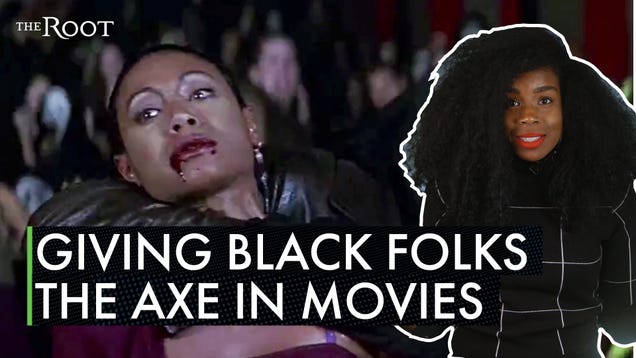
Why'd They Kill Tyrone? Unpacking Blackness in Horror Films

Black folks don’t do horror—right?! Wrong.

Read more...


from The Root https://ift.tt/2WnCWOJ

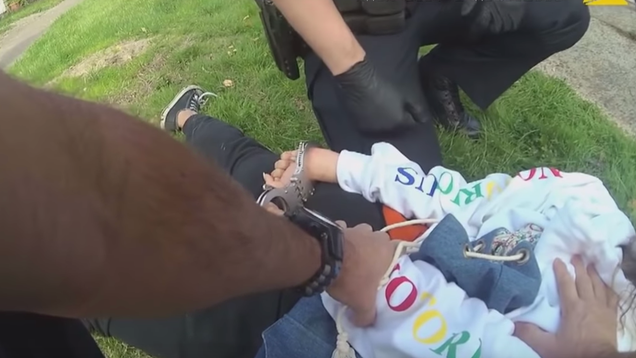
Watch: Oregon Police Arrest Black Woman for Knowing Her Rights

One of my favorite things on the internet is the genre of YouTube videos posted by white people illustrating to police officers their knowledge of their constitutional rights. They carry guns and don’t get shot in the back. They don’t even roll their windows down during traffic stops because it’s their right! This is…

Read more...


from The Root https://ift.tt/2PlClvg

Atlanta rap group Migos made at rain at a strip club in L.A.

Anything goes with the Hunchos!

Migos members, OffsetTakeoffQuavo were throwing racks at fat booties inside VLive, a strip club in L.A., and it was seriously a hurricane of $45,000 worth of cash flowing.

READ MORE: Offset’s baby momma wants regularly scheduled child support payments

The rappers were on hand to support Quavo’s girlfriend Saweetie who was hosting the strip club’s Reign Sundays series, TMZ reports.

And the rappers flooded the floor with cash and dipped in less than an hour. They reportedly came in at 1:20 AM and left by 2 AM.

The “Stripper Bowl rappers are used to making it ran and in Feb. dropped $500k at a strip club in Atlanta.

But it’s interesting that so much money was dumped in a strip club, when Offset’s baby momma has alleged that he doesn’t give her enough child support to sustain taking care of their child.

TMZ reports that Nicole Marie Algarin, the mother of Offset’s 4-year-old daughter Kalea, filed court papers asking for more child support to care for their daughter and she wants the judge to invoke court order payments.

Algarin who goes by Shya L’amour is saying that the Migos front man provides “limited financial support” for their daughter, and it seems as if he’s not giving her payments in regular intervals.

Algarin is not only asking for more money, but she wants the court to make payments official so that she can get those child support checks on a regular rotation.

READ MORE: Offset’s oldest daughter’s mother says Cardi B has made him a better man

Offset has reportedly already claimed his kid, and she contends that there’s no dispute as far as determining if the child’s father. DNA has been proven a match, since the two have already taken the test.

Well proof that he’s throwing stacks in the club at strangers surely won’t help his case if he says he can’t afford more child support. Just saying.

The post Atlanta rap group Migos made at rain at a strip club in L.A. appeared first on theGrio.


from theGrio https://ift.tt/32KBacA